Skip to content Skip to sidebar Skip to footer

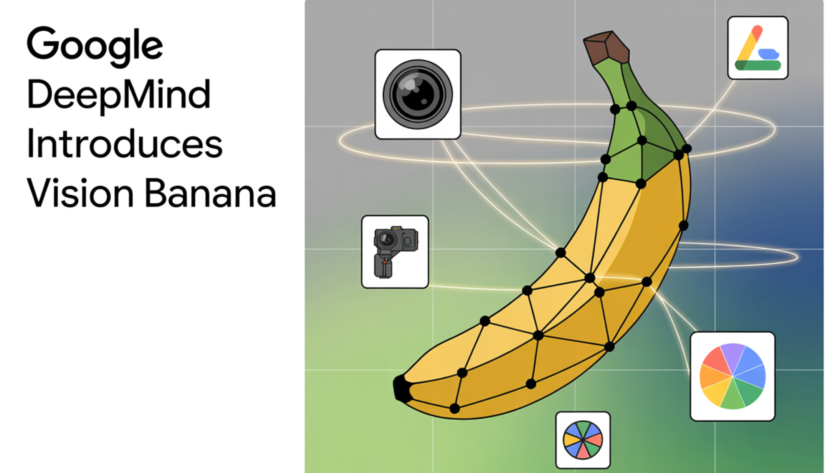
Google DeepMind Introduces Vision Banana: An Instruction-Tuned Image Generator That Beats SAM 3 on Segmentation and Depth Anything V3 on Metric Depth Estimation

For years, the computer vision community has operated on two separate tracks: generative models (which produce images) and discriminative models (which understand them). The assumption was straightforward — models good at making pictures aren’t necessarily good at reading them. A new paper from Google, titled “Image Generators are Generalist Vision Learners” (arXiv:2604.20329), published April 22,…

Read More

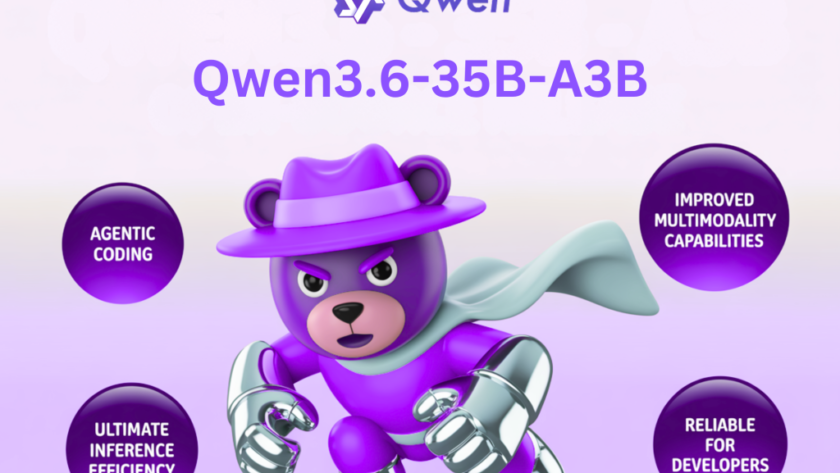
Qwen Team Open-Sources Qwen3.6-35B-A3B: A Sparse MoE Vision-Language Model with 3B Active Parameters and Agentic Coding Capabilities

The open-source AI landscape has a new entry worth paying attention to. The Qwen team at Alibaba has released Qwen3.6-35B-A3B, the first open-weight model from the Qwen3.6 generation, and it is making a compelling argument that parameter efficiency matters far more than raw model size. With 35 billion total parameters but only 3 billion activated…

Read More

Meta Superintelligence Lab Releases Muse Spark: A Multimodal Reasoning Model With Thought Compression and Parallel Agents

Meta Superintelligence Labs recently made a significant move by unveiling ‘Muse Spark’ — the first model in the Muse family. Muse Spark is a natively multimodal reasoning model with support for tool-use, visual chain of thought, and multi-agent orchestration. https://ai.meta.com/static-resource/muse-spark-eval-methodology What ‘Natively Multimodal’ Actually Means When Meta describes Muse Spark as ‘natively multimodal,’ it means…

Read More

How to Build a Netflix VOID Video Object Removal and Inpainting Pipeline with CogVideoX, Custom Prompting, and End-to-End Sample Inference

In this tutorial, we build and run an advanced pipeline for Netflix’s VOID model. We set up the environment, install all required dependencies, clone the repository, download the official base model and VOID checkpoint, and prepare the sample inputs needed for video object removal. We also make the workflow more practical by allowing secure terminal-style…

Read More

A Coding Guide to Build a Scalable End-to-End Machine Learning Data Pipeline Using Daft for High-Performance Structured and Image Data Processing

In this tutorial, we explore how we use Daft as a high-performance, Python-native data engine to build an end-to-end analytical pipeline. We start by loading a real-world MNIST dataset, then progressively transform it using UDFs, feature engineering, aggregations, joins, and lazy execution. Also, we demonstrate how to seamlessly combine structured data processing, numerical computation, and…

Read More

[Tutorial] Building a Visual Document Retrieval Pipeline with ColPali and Late Interaction Scoring

import subprocess, sys, os, json, hashlib def pip(cmd): subprocess.check_call([sys.executable, "-m", "pip"] + cmd) pip(["uninstall", "-y", "pillow", "PIL", "torchaudio", "colpali-engine"]) pip(["install", "-q", "--upgrade", "pip"]) pip(["install", "-q", "pillow<12", "torchaudio==2.8.0"]) pip(["install", "-q", "colpali-engine", "pypdfium2", "matplotlib", "tqdm", "requests"]) Source link

Read More

Waymo Introduces the Waymo World Model: A New Frontier Simulator Model for Autonomous Driving and Built on Top of Genie 3

Waymo is introducing the Waymo World Model, a frontier generative model that drives its next generation of autonomous driving simulation. The system is built on top of Genie 3, Google DeepMind’s general-purpose world model, and adapts it to produce photorealistic, controllable, multi-sensor driving scenes at scale. Waymo already reports nearly 200 million fully autonomous miles…

Read More

NVIDIA AI releases C-RADIOv4 vision backbone unifying SigLIP2, DINOv3, SAM3 for classification, dense prediction, segmentation workloads at scale

How do you combine SigLIP2, DINOv3, and SAM3 into a single vision backbone without sacrificing dense or segmentation performance? NVIDIA’s C-RADIOv4 is a new agglomerative vision backbone that distills three strong teacher models, SigLIP2-g-384, DINOv3-7B, and SAM3, into a single student encoder. It extends the AM-RADIO and RADIOv2.5 line, keeping similar computational cost while improving…

Read More