

All 25 announcements from Orlando, what’s actually shipping vs. what’s marketing — and what it means for the document and data foundation of the autonomous enterprise.
SAP’s Sapphire 2026 in Orlando was the most AI-dense keynote in the company’s history. Christian Klein didn’t unveil a roadmap. He unveiled capabilities — 25 of them, by our count — ranging from a fundamental repositioning of SAP itself to an embedded Model Context Protocol server, a €1B+ commitment to tabular foundation models, and a robotics partnership packing boxes in SAP’s own logistics center.
And yet, while Klein was on stage announcing the Autonomous Enterprise, SAP’s stock sat ~28–32% down year-to-date. Analysts kept Buy ratings but quietly reframed AI as “an adoption topic, not a revenue driver yet.”
That tension — between the boldness of the vision and the patience of the market — is the most important thing to understand about Sapphire 2026. Below is the complete breakdown: all 25 announcements numbered as they appear, grouped into the seven themes that matter.
Theme 1: The Repositioning
1. The “Autonomous Enterprise” is the new vision. SAP is becoming a “business AI company,” not just a software company. Joule, SAP’s assistant, delivered the framing line from the keynote stage. The implication: SAP isn’t competing with Workday and Oracle anymore — it’s competing with Salesforce, ServiceNow, and the agentic AI players for the layer that acts on enterprise data, not just records it.
2. SAP Business AI Platform unifies SAP Business Technology Platform (BTP), Business Data Cloud (BDC), and Business AI into a single stack. It’s a consolidation more than a brand-new product — but the signal matters: SAP is positioning one foundation layer above the apps, not three.
Our read: The repositioning is meaningful. But SAP has tried versions of this story before. The question isn’t whether SAP wants to be a business AI company. It’s whether it can actually ship working AI in production, where every prior attempt has stalled.
Theme 2: The Agent Stack
3. SAP Knowledge Graph — SAP turned 452,000 tables and 7.3M fields into machine-readable semantics for agents to reason against. This is the under-the-hood plumbing that lets Joule agents understand SAP’s own data model.
4. 50+ Joule Assistants — domain-specific chat/copilot helpers across finance, procurement, supply chain, HR, and customer experience.
5. 200+ specialized AI agents / “Autonomous Suite” — the agents the assistants orchestrate. Includes Joule for Developers and an ABAP code conversion agent going GA. The only Joule agent with a hard, publicly-stated metric: a 40% efficiency target.
6. Joule Studio 2.0 GA — the build-and-govern environment for agents. Free design-time access through December 31, 2026.
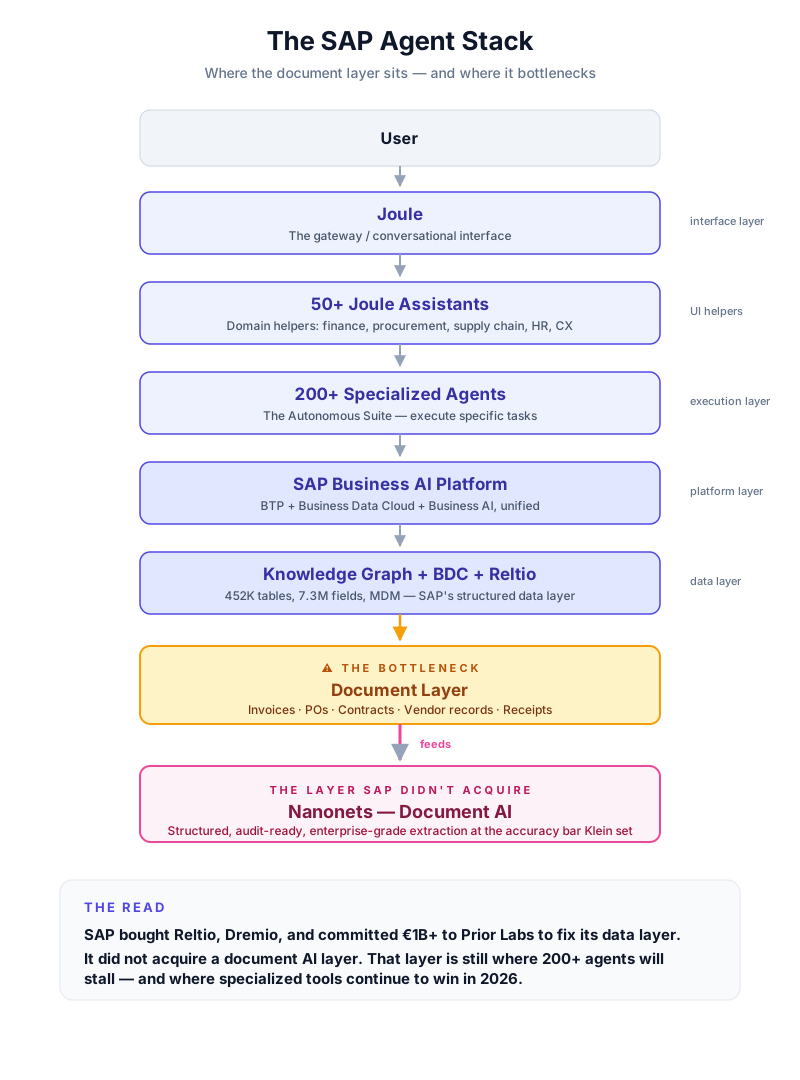
Our read: The Knowledge Graph is the most underappreciated announcement of Sapphire. Without semantic understanding across 452K tables, no agent can reason coherently across SAP data. This is structural plumbing that compounds for years.
The Joule Assistants are harder to evaluate. SAP has been shipping assistants for years — S/4HANA copilots, Joule v1 — and nothing has worked in production at scale. These are UI helpers, not workflow replacements, and that distinction tends to disappear in marketing materials.
The 200+ agent number is impressive on paper, but Salesforce ran this exact playbook with Agentforce twelve months ago, and the production reality fell well short of the pitch. The 40% efficiency target on the ABAP agent is the only number with teeth. Watch what gets quantified next — and what doesn’t.
Theme 3: The Ecosystem Opens
7. SAP AI Agent Hub — a vendor-agnostic marketplace for agents (SAP and third-party). GA Q3 2026. SAP has reportedly taken 680+ partner submissions.
8. Model Context Protocol (MCP) embedded in Business Data Cloud and Reltio. Third-party agents — built outside SAP — can plug into SAP’s data layer through an open protocol, not a proprietary integration.
9. n8n partnership and SAP equity stake at a reported $5.2B valuation. Workflow orchestration embedded directly in Joule Studio.
10. Strategic partnerships across the stack: Anthropic (Claude becomes a primary reasoning model embedded across Joule), AWS (zero-copy integration with Athena), Google Cloud + Microsoft (bidirectional Agent-to-Agent / A2A protocol, GA Q4 2026), Mistral and Cohere (sovereign model options), NVIDIA (OpenShell as the secure runtime for Joule Studio).
Our read: This is the structural shift that matters most. For the first time, SAP is opening defined interop paths — MCP, A2A, the AI Agent Hub — that let specialized AI tools plug into the SAP ecosystem without proprietary engineering. The walled garden is becoming a network.
Practically: if Joule Assistants get a finance or procurement workflow 70–80% of the way there, the last 20–30% — accurate document extraction, vendor data enrichment, contract intelligence, edge-case automation — can now be handled by specialized agents communicating over MCP. That’s a fundamentally different vendor landscape than the one we had at Sapphire 2025.
Theme 4: Data Foundation Moves
11. Reltio acquisition closed — master data management for SAP and non-SAP environments. Reltio’s strength is connecting to non-SAP sources and handling complex multi-source data — exactly where SAP’s native stack has been thin.
12. Dremio acquisition (data lakehouse), expected to close Q3 2026.
13. €1B+ commitment to Prior Labs for tabular foundation models (SAP-RPT-1.5). Relevant for structured data extraction — turning messy business data into structured rows agents can consume.
Our read: Three moves of this magnitude is SAP saying out loud what enterprise teams have known for years: the data flowing into SAP — from documents, from non-SAP systems, from unstructured sources — is not in a state where agents can reliably consume it. Reltio addresses cross-system master data. Dremio addresses the lakehouse layer. Prior Labs addresses unstructured-to-structured conversion.
What’s notably not addressed is the document layer itself. Invoices, contracts, POs, vendor onboarding paperwork, receipts. The text and structured data inside business documents still has to land in clean, validated form in SAP’s data layer before any agent can act on it. That extraction layer is where specialized players continue to win — and where SAP is, again this year, leaving the field open.
Theme 5: Customer Proof Points
14. JPMorgan is moving its general ledger to SAP. The single biggest customer win announced at Sapphire and, frankly, the year.
15. 26 industries covered at GA with industry-specific agents — consumer/retail, oil & gas, mining, engineering, agriculture, banking, insurance, and more. H&M’s unified commerce went live as a keynote demo.
16. Physical AI — Cyberwave robotics partnership. Autonomous packing in SAP’s own logistics center.
17. Expanded sovereign cloud, including India.
Our read: The JPMorgan GL win is the most strategically significant customer announcement of 2026. Banks moving a general ledger is rare, conservative, and signals deep institutional commitment. That alone gives the Sapphire narrative more credibility than the agent count does.
The 26-industry coverage is more breadth than depth — expect the industry agents to be uneven in production, with strong ones in retail and supply chain and weaker ones in regulated verticals where data and compliance complexity is higher.
The Physical AI demo grabs headlines but won’t move enterprise budgets in 2026. Sovereign cloud expansion to India, on the other hand, is meaningful — data residency has been a genuine blocker for SAP cloud adoption in Indian enterprises, and removing it opens a large market.
Theme 6: The Migration Problem
18. Parloa partnership for AI agents in SAP Service Cloud.
19. Palantir + Accenture as implementation partners for complex migration scenarios.
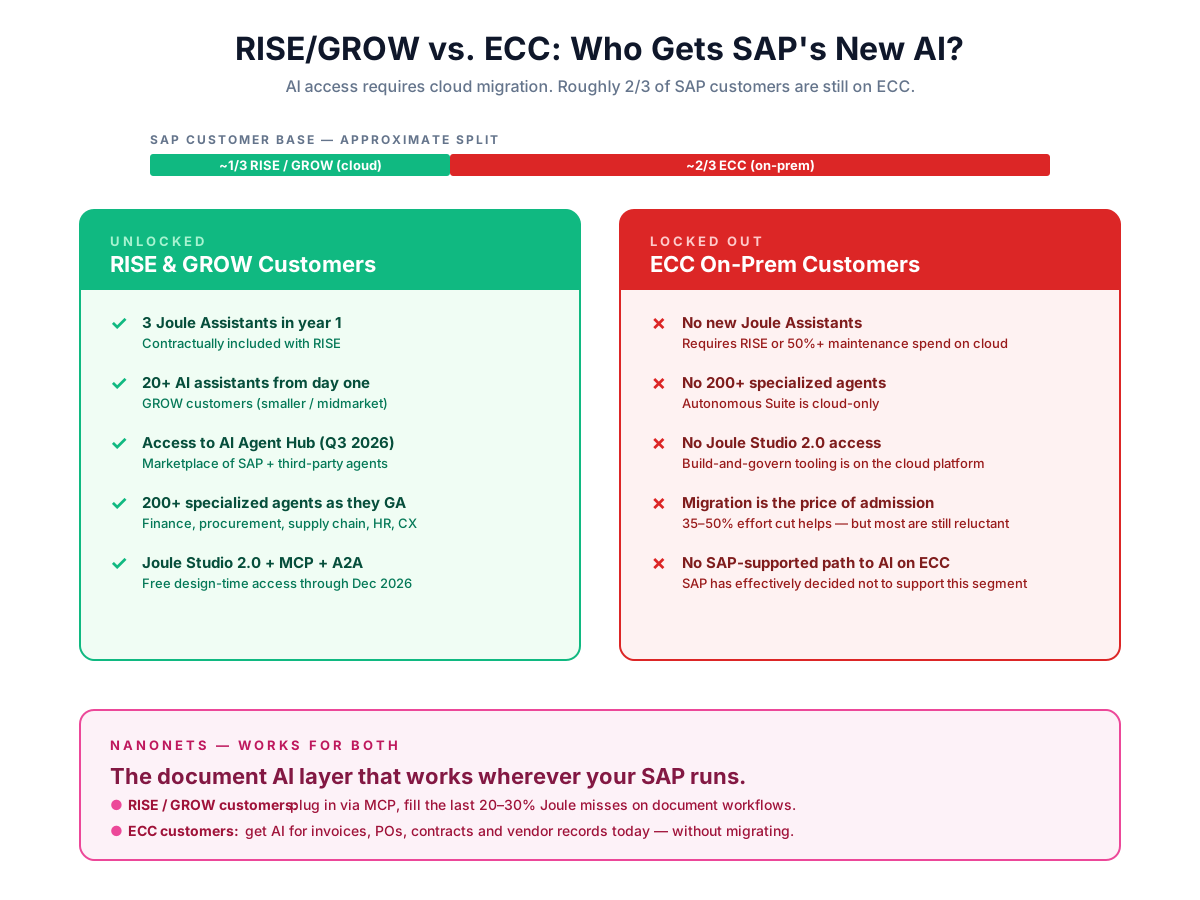
20. RISE with SAP reset: 3 Joule Assistants contractually included in year one, with the Max Success Plan extending adoption across the enterprise.
21. SAP GROW reset: 20+ AI assistants from day one (positioned for smaller and midmarket customers).
22. €100M partner fund for partners deploying AI assistants or building on Joule Studio.
23. Migration assistants: 35%+ effort reduction, up to 50%, for S/4HANA migrations.
24. AI access requires cloud migration. Customers must be on RISE, or move at least 50% of maintenance spend to cloud, to use the new AI features. Approximately two-thirds of SAP’s base is still on ECC or on-prem.
Our read: This is where the marketing meets the wall. S/4HANA migration has been a slog for years — most ECC customers are reluctant, and the migration tooling improvements feel like a forced acceleration push. Tying AI access to cloud migration creates an explicit forcing function: SAP wants enterprises to migrate to access agents.
But the math is uncomfortable. Two-thirds of the SAP base is on ECC, and most of them don’t want to move on SAP’s preferred timeline. SAP has effectively decided not to support AI for those customers. That creates a real and growing market for tooling that lets ECC customers adopt AI at the document and process layer while staying on ECC until they’re ready to migrate on their own terms.
The Parloa partnership tells you something else: SAP is willing to white-flag specific functional areas. Parloa is a customer service AI play, and SAP brought them in because SAP couldn’t keep up with Salesforce in CS. Expect that pattern — bring in a specialist where the gap is widest — to repeat across other functions.
Theme 7: The Market Reaction
25. SAP’s stock was down ~28–32% YTD heading into Sapphire. Analysts maintained Buy ratings but flagged AI as “an adoption topic, not a revenue driver yet.”
The €100M partner fund, the AI-density of the keynote, the rapid-fire acquisitions — these are responses to investor skepticism as much as they are responses to customer demand. SAP needed Sapphire 2026 to look like an AI company. It did. The market hasn’t yet been convinced it is one.
That gap between narrative and conviction is the most honest signal coming out of Orlando.
What This Actually Means for Enterprise AI Buyers
Strip away the keynote choreography and Sapphire 2026 tells a coherent story for SAP customers:
1. The agent layer is real but immature. Joule Assistants and the 200+ agents are shipping, but they’re best understood as copilot helpers today, not autonomous workflow replacements. Salesforce’s Agentforce is the relevant case study, and that hasn’t yet lived up to its pitch.
2. The interop story changes the vendor landscape. MCP in BDC and Reltio, A2A by Q4, the AI Agent Hub marketplace by Q3 — together, these announcements say SAP is opening up. Specialized agents will plug in. The best-of-breed era is back, even inside SAP environments.
3. The data and document foundation problem is bigger than SAP is letting on. Three acquisitions (Reltio, Dremio, Prior Labs) and a €1B+ commitment to tabular foundation models. SAP is buying its way into a data layer it doesn’t have. The document layer — invoices, POs, contracts, vendor records — sits adjacent to all of these moves and remains the dominant bottleneck for agent reliability.
4. Two-thirds of SAP customers are stranded. ECC users can’t access the new AI features without migrating. Most won’t migrate on SAP’s preferred timeline. There’s a real, growing, and underserved market for AI tooling that works on ECC today.
5. The 80% accuracy bar Klein set is a brutal filter. “Eighty percent accuracy isn’t sufficient when running mission-critical businesses.” Every agent shipped in 2026 will be measured against that line. Most won’t clear it without enterprise-grade structured inputs upstream.
Where Nanonets Fits
The autonomous enterprise has a quiet bottleneck: agents are only as good as the documents and structured data they’re grounded in.
Nanonets builds the document AI layer that turns the unstructured input flowing into SAP — invoices, POs, contracts, vendor records, receipts — into the structured, audit-ready, enterprise-grade data that Joule Assistants and SAP’s 200+ agents need to actually work in production.
We integrate with SAP S/4HANA and SAP Ariba today. We also work in ECC environments where Joule doesn’t yet reach — which matters for the two-thirds of the SAP base that won’t migrate on SAP’s timeline. And we’re built explicitly for the accuracy bar Klein set publicly in Orlando.
With MCP now embedded in SAP Business Data Cloud and Reltio, and the SAP AI Agent Hub going GA in Q3, the integration paths for specialized AI tools into SAP environments are about to be fundamentally more open than they’ve ever been. We’re tracking those timelines closely and building toward them.
If you’re rethinking your document and data foundation for the autonomous enterprise era — whether you’re on RISE, GROW, or still on ECC — we’d love to compare notes.
Sources: SAP News Center, SAP Community, ERP Today, Constellation Research, SAPinsider, Channel Insider, ad-hoc-news, SAVIC Technologies. Quotes and metrics drawn from Christian Klein’s Sapphire 2026 keynote and the official SAP Sapphire 2026 announcements.