Current end-to-end robotic policies, specifically Vision-Language-Action (VLA) models, typically operate on a single observation or a very short history. This ‘lack of memory’ makes long-horizon tasks, such as cleaning a kitchen or following a complex recipe, computationally intractable or prone to failure. To address this, researchers from Physical Intelligence, Stanford, UC Berkeley, and MIT have…
Building simulators for robots has been a long term challenge. Traditional engines require manual coding of physics and perfect 3D models. NVIDIA is changing this with DreamDojo, a fully open-source, generalizable robot world model. Instead of using a physics engine, DreamDojo ‘dreams’ the results of robot actions directly in pixels.
https://arxiv.org/pdf/2602.06949
Scaling Robotics with 44k+…
Robots are entering their GPT-3 era. For years, researchers have tried to train robots using the same autoregressive (AR)…
How do you build a single vision language action model that can control many different dual arm robots in the real world? LingBot-VLA is Ant Group Robbyant’s new Vision Language Action foundation model that targets practical robot manipulation in the real world. It is trained on about 20,000 hours of teleoperated bimanual data collected from 9…
Google DeepMind has released SIMA 2 to test how far generalist embodied agents can go inside complex 3D game worlds. SIMA’s (Scalable Instructable Multiworld Agent) new version upgrades the original instruction follower into a Gemini driven system that reasons about goals, explains its plans, and improves from self play in many different environments.
From…
How do you build a single model that can learn physical skills from chaotic real world robot data without relying on simulation? Generalist AI has unveiled GEN-θ, a family of embodied foundation models trained directly on high fidelity raw physical interaction data instead of internet video or simulation. The system is built to establish scaling…
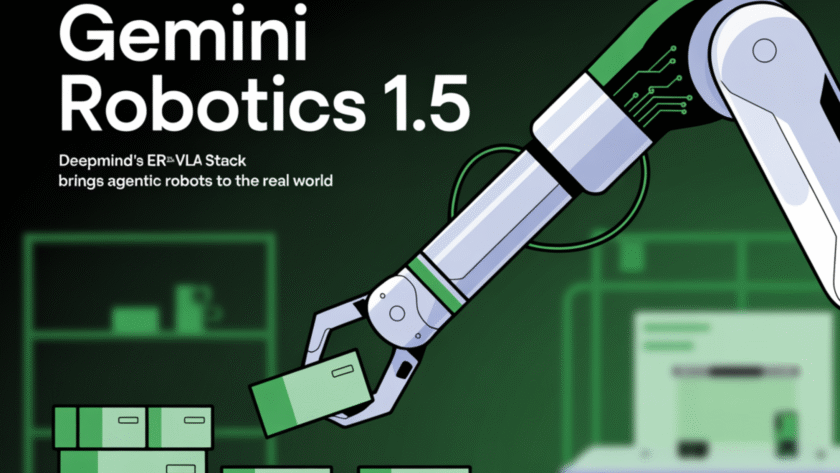
Can a single AI stack plan like a researcher, reason over scenes, and transfer motions across different robots—without retraining from scratch? Google DeepMind’s Gemini Robotics 1.5 says yes, by splitting embodied intelligence into two models: Gemini Robotics-ER 1.5 for high-level embodied reasoning (spatial understanding, planning, progress/success estimation, tool-use) and Gemini Robotics 1.5 for low-level visuomotor…
What Do We Mean by “Physical AI”?
Artificial intelligence in robotics is not just a matter of clever algorithms. Robots operate in the physical world, and their intelligence emerges from the co-design of body and brain. Physical AI describes this integration, where materials, actuation, sensing, and computation shape how learning policies function. The term was…
In this tutorial, we walk step by step through using Hugging Face’s LeRobot library to train and evaluate a behavior-cloning policy on the PushT dataset. We begin by setting up the environment in Google Colab, installing the required dependencies, and loading the dataset through LeRobot’s unified API. We then design a compact visuomotor policy that…
Robotics and artificial intelligence are converging at an unprecedented pace, driving breakthroughs in automation, perception, and human-machine collaboration. Staying current with these advancements requires following specialized sources that deliver technical depth, research updates, and industry insights. The following list highlights 12 of the most authoritative robotics and AI-focused blogs and websites to track in 2025.…