Skip to content Skip to sidebar Skip to footer

AI-Powered Feature Engineering with n8n: Scaling Data Science Intelligence

Image by Author | ChatGPT   #  Introduction   Feature engineering gets called the 'art' of data science for good reason — experienced data scientists develop this intuition for spotting meaningful features, but that knowledge is tough to share across teams. You'll often see junior data scientists spending hours brainstorming potential features, while senior folks end…

Read More

Meta CLIP 2: The First Contrastive Language-Image Pre-training (CLIP) Trained with Worldwide Image-Text Pairs from Scratch

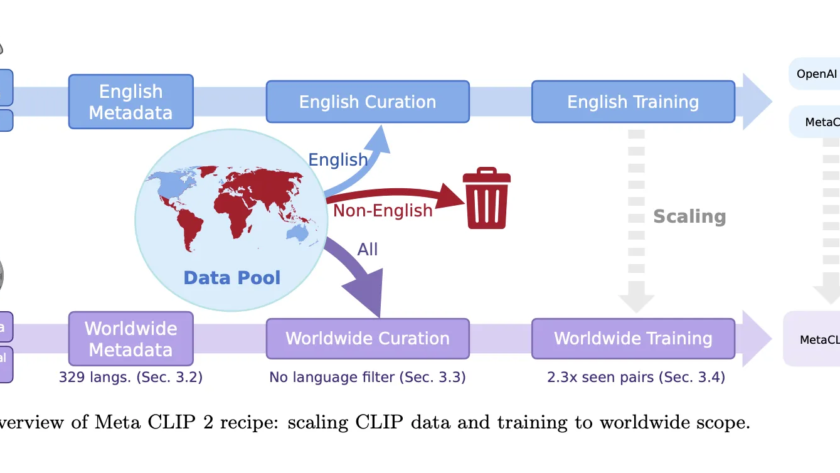
Contrastive Language-Image Pre-training (CLIP) has become important for modern vision and multimodal models, enabling applications such as zero-shot image classification and serving as vision encoders in MLLMs. However, most CLIP variants, including Meta CLIP, are limited to English-only data curation, ignoring a significant amount of non-English content from the worldwide web. Scaling CLIP to include…

Read More

NVIDIA AI Releases GraspGen: A Diffusion-Based Framework for 6-DOF Grasping in Robotics

Robotic grasping is a cornerstone task for automation and manipulation, critical in domains spanning from industrial picking to service and humanoid robotics. Despite decades of research, achieving robust, general-purpose 6-degree-of-freedom (6-DOF) grasping remains a challenging open problem. Recently, NVIDIA unveiled GraspGen, a novel diffusion-based grasp generation framework that promises to bring state-of-the-art (SOTA) performance with unprecedented…

Read More

Enterprise AI Investments 2025: Top Use-Cases

TLDR Content‑generation AI and Code‑generation AI together soak up ≈ $50 B+ in U.S. VC capital, dwarfing every other category. Cyber‑Sec, RPA, and Conversational AI - lead enterprise deployment charts. They win on clear ROI, fast time‑to‑value, and rich vendor ecosystems. 1. Use-Cases with the Widest Enterprise Adoption We’ve established that Enterprise spend on AI will be…

Read More

Apple Researchers Introduce FastVLM: Achieving State-of-the-Art Resolution-Latency-Accuracy Trade-off in Vision Language Models

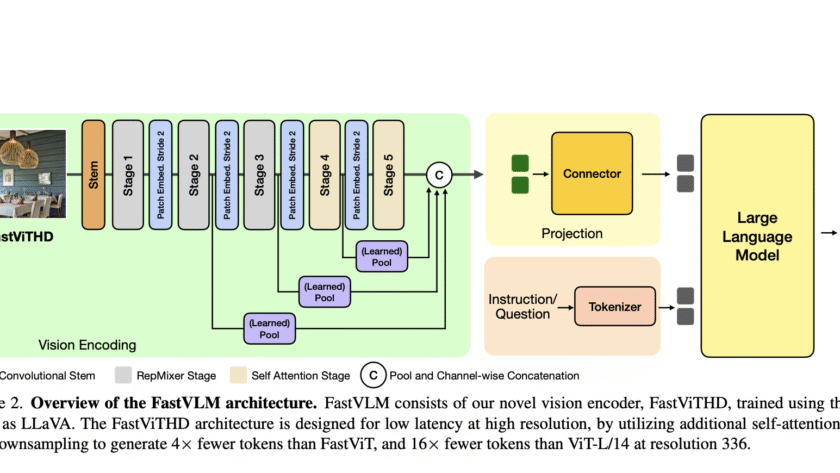
Vision Language Models (VLMs) allow both text inputs and visual understanding. However, image resolution is crucial for VLM performance for processing text and chart-rich data. Increasing image resolution creates significant challenges. First, pretrained vision encoders often struggle with high-resolution images due to inefficient pretraining requirements. Running inference on high-resolution images increases computational costs and latency…

Read More

Deep Think is now rolling out

How Deep Think works: extending Gemini’s parallel “thinking time” Just as people tackle complex problems by taking the time to explore different angles, weigh potential solutions, and refine a final answer, Deep Think pushes the frontier of thinking capabilities by using parallel thinking techniques. This approach lets Gemini generate many ideas at once and consider…

Read More

NVIDIA AI Presents ThinkAct: Vision-Language-Action Reasoning via Reinforced Visual Latent Planning

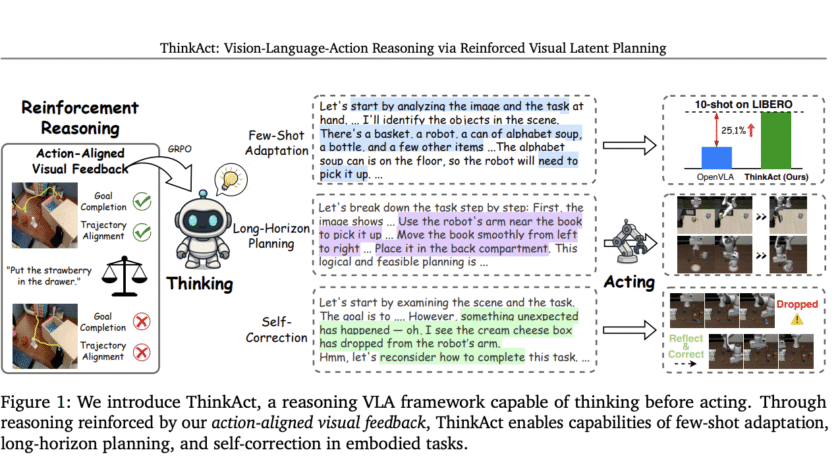
Estimated reading time: 5 minutes Introduction Embodied AI agents are increasingly being called upon to interpret complex, multimodal instructions and act robustly in dynamic environments. ThinkAct, presented by researchers from Nvidia and National Taiwan University, offers a breakthrough for vision-language-action (VLA) reasoning, introducing reinforced visual latent planning to…

Read More